Best Robotic Mower Options: The Definitive 2026 Editorial Reference
The adoption of autonomous turf management represents a significant departure from the traditional American weekend ritual of manual mowing. As we move through 2026, the technology has transitioned from a niche curiosity into a robust utility for property stewardship. The shift is driven by a convergence of high-precision satellite positioning, advanced battery chemistry, and a growing cultural emphasis on quiet, emissions-free landscaping. This evolution is not merely about convenience; it is a fundamental reconfiguration of how we interact with and maintain residential and commercial green spaces.
The complexity of selecting a professional-grade autonomous mower lies in the invisible infrastructure that supports it. Unlike a standard push mower, which is an isolated mechanical tool, a robotic system is a node within a broader digital and environmental ecosystem. It requires a stable network backhaul, a nuanced understanding of topographical constraints, and a long-term maintenance strategy. For the property owner, the challenge is navigating a market that has matured rapidly, moving from rudimentary “ping-pong” navigation to sophisticated, systematic striping powered by RTK-GPS.
Achieving true topical mastery in this field requires looking past the marketing specifications and examining the “Intelligence Density” of the hardware. A machine that performs flawlessly on a flat, rectangular suburban lot may fail catastrophically on a complex, multi-zone estate with significant tree canopy or steep gradients. Consequently, the selection process must be rooted in a strategic assessment of “Environmental Compatibility”—matching the specific technical capabilities of the mower to the physical realities of the landscape. This definitive reference provides the analytical framework necessary to evaluate and implement the premier autonomous solutions available today.
Understanding “best robotic mower options”
To identify the best robotic mower options, one must move beyond the superficial metrics of blade speed or cutting width to the underlying “Navigation Integrity.” In the professional segment, excellence is defined by a system’s ability to maintain a sub-inch level of precision in varying environmental conditions. A common misunderstanding among consumers is the belief that all “smart” mowers operate on the same logic. In reality, there is a vast technological chasm between “Random Path” units, which rely on physical boundary wires and chaotic movement, and “Systematic” units, which use Real-Time Kinematic (RTK) GPS to mow in efficient, parallel lines.
A frequent oversimplification in this field is the “Slope Fallacy”—the assumption that a mower’s rated incline capacity applies to all parts of the yard. In practice, a mower’s ability to navigate a 45% slope depends heavily on its “Drive Architecture” (All-Wheel Drive vs. Rear-Wheel Drive) and the moisture content of the turf. When you evaluate the best robotic mower options, you are essentially auditing the machine’s “Torque-to-Traction” ratio. A high-torque motor is useless if the tire tread pattern and weight distribution lead to turf tearing on a damp morning.
Furthermore, the “Best” option is always contextual to the “Network Topology” of the property. A satellite-based mower requires a clear line-of-sight to the sky. On a heavily wooded property in the Pacific Northwest, a traditional wire-based system or a vision-based unit (utilizing onboard cameras and SLAM technology) might actually be the superior choice. Thus, the selection process is an editorial act of balancing technological ambition with geographical honesty. The goal is “Frictionless Autonomy,” where the machine performs its duties without human intervention for weeks at a time.
Contextual Evolution: From Perimeter Wires to Satellite Precision
The history of autonomous mowing has progressed through three distinct eras: the Perimeter Era, the Vision Era, and the Satellite Era. The Perimeter Era, which began in the late 1990s, relied on “Geofencing” via a buried low-voltage wire. While reliable, these systems were labor-intensive to install and prone to “Wire Breaks” caused by rodents or aerators. The movement was random, meaning the mower would bounce off the wire until the entire area was eventually covered, a process that was inefficient for large acreages.
The Vision Era introduced onboard cameras and rudimentary AI to identify the “Mowable Zone” based on visual contrast between grass and mulch. While this eliminated the need for wires, early versions struggled with low-light conditions or ambiguous borders. We are now firmly in the Satellite/RTK Era. By utilizing a local base station to provide a “Correction Signal” to the mower, these systems achieve centimeter-level accuracy. This allows for systematic striping, multi-zone management, and “Digital No-Go Zones,” turning the mower into a precision instrument rather than a wandering appliance.
Conceptual Frameworks and Mental Models
Navigating the complexities of autonomous turf care requires specific mental models to evaluate long-term utility:
-
The “Mean Time Between Interventions” (MTBI): This is the primary metric for system success. If a property owner has to “rescue” a mower from a hole or a transition zone more than once a week, the system has failed the autonomy test. The goal is an MTBI of 30 days or more.
-
The “Blade-to-Bout” Efficiency: This model calculates the total energy expended per square foot. Systematic mowers (RTK) are typically 3x more efficient than random-path mowers because they do not cover the same patch of grass multiple times.
-
The “Local-First” Logic: Critical safety and navigation decisions (like obstacle avoidance) must happen on the “Edge”—the mower itself—rather than in the cloud. A mower that requires a constant 5G connection to avoid a pet is a liability.
Key Categories of Autonomous Mowing Systems
Selecting the right system requires a breakdown by navigation type and physical architecture.
| Category | Navigation Technology | Best For | Main Trade-off |
| Boundary Wire | Low-Voltage Signal | Small, Simple Lots | High installation labor; random path |
| RTK-GPS | Satellite + Base Station | Large, Open Acreage | Requires clear sky view; higher cost |
| Vision-Based | AI Cameras / SLAM | Wooded or Shaded Areas | Struggling with shadows/low light |
| Hybrid (Wire+GPS) | Dual-Layer | High-Reliability Needs | Complex setup; redundant cost |
| AWD Specialized | High-Torque Motors | Steep Embankments | Shorter battery life; heavier weight |
Realistic Decision Logic
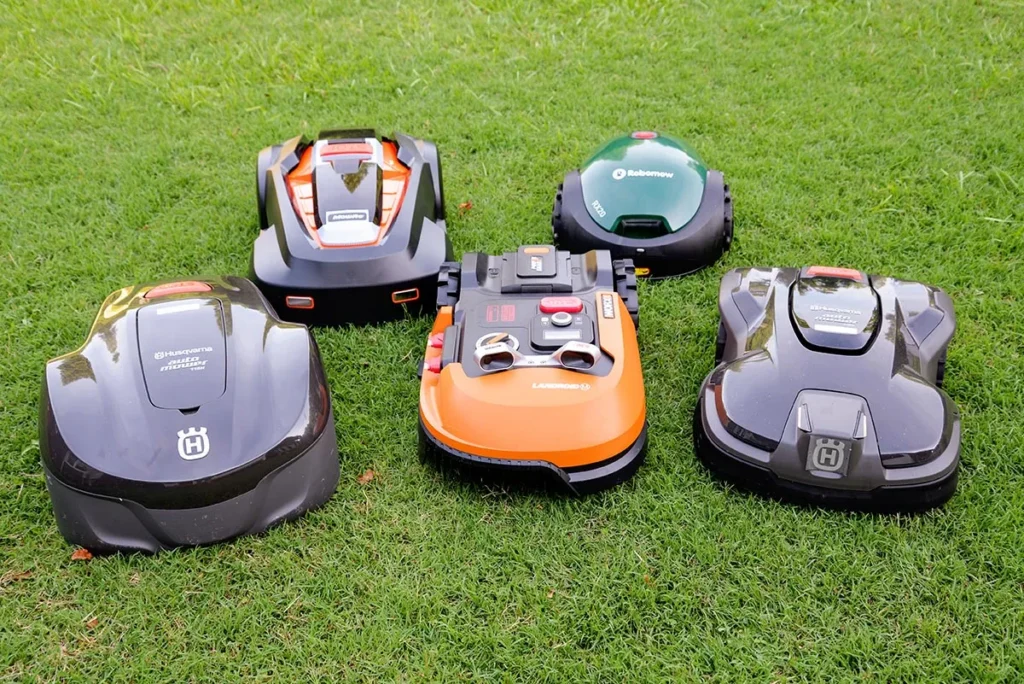
A critical decision for the homeowner is the choice between Proprietary Ecosystems and Interoperable Platforms. While brands like Husqvarna and Worx offer seamless, vertical integration, some emerging professional platforms allow the mower to be integrated into a broader “Smart Landscape” hub. In 2026, the preference is shifting toward units that can communicate with the irrigation system—ensuring the mower isn’t running while the sprinklers are active, which prevents “Grass Clumping” and reduces mechanical wear.
Detailed Real-World Scenarios and Constraints
Scenario 1: The Heavily Wooded “Canopy” Lot
On a property in Georgia with dense oak trees, a standard RTK-GPS mower will lose its signal.
-
The Strategy: Use a vision-based unit or a “Lease-Line” boundary wire system.
-
Failure Mode: “Signal Drift” where the mower thinks it is on the lawn but is actually driving into the swimming pool because it lost satellite lock.
-
Constraint: Requires a mower with a 360-degree camera array to navigate via “Visual Landmarks.”
Scenario 2: The Multi-Zone Estate with Hardscape
A property where the lawn is split by a driveway or a stone path.
-
The Strategy: A systematic mower capable of “Driveway Crossing.” This requires the mower to lift its cutting deck and travel across a non-grass surface to reach a secondary zone.
-
Automation Focus: Programming “Stay-Out” periods during high-traffic hours to prevent the mower from becoming a hazard to vehicles.
Planning, Cost, and Resource Dynamics
The financial architecture of a robotic mower project is defined by the “Total Cost of Ownership” (TCO) over a 10-year period.
| Component | Entry-Level unit | Professional RTK System | 10-Year Value Driver |
| Initial Purchase | $800 – $1,500 | $3,500 – $12,000 | Durability of brushless motors |
| Installation | $200 (DIY) | $500 – $1,500 | Precision of digital mapping |
| Consumables | $50/yr (Blades) | $100/yr (Blades/Filter) | “Little and Often” cutting health |
| Battery Replacement | $150 (Year 4) | $400 (Year 6) | Higher quality LiFePO4 cells |
Opportunity Cost: Choosing a cheap, underpowered mower for a large lot results in “Over-Cycling,” where the mower runs 24/7 just to keep up. This leads to premature battery failure and motor burnout, effectively doubling the cost of the investment within three years.
Tools, Strategies, and Support Systems
A definitive installation for the best robotic mower options utilizes the following support layers:
-
RTK Base Station Placement: Must be at the highest point of the property with a 360-degree sky view to ensure the “Correction Data” reaches the mower even behind the house.
-
“Garage” Protective Housing: A simple UV-shielding “Dog House” can extend the lifespan of the mower’s plastic casing and battery by up to 30% by reducing thermal stress during charging.
-
Winterization Strategy: Storing the mower in a climate-controlled area during sub-zero months is non-negotiable for preserving battery chemistry.
-
Firmware Governance: Professional systems allow for “Rolled-Back” updates; if a new software version causes navigation bugs, the owner can revert to a stable version.
Risk Landscape and Failure Modes
The “Taxonomy of Risk” in autonomous mowing includes both mechanical and environmental factors:
-
“Traction-Loss” Damage: If a mower gets stuck and continues to spin its wheels, it can “Burn” a hole in the turf in minutes. Modern units must have “Stall Detection.”
-
The “Object Identification” Gap: While most mowers stop for large objects, small items like dog toys or garden hoses are often “mulched,” leading to blade damage.
-
The “Connectivity Blackout”: For GPS-dependent units, solar flares or heavy atmospheric interference can occasionally degrade accuracy, requiring a “Safety-Pause” protocol.
Governance, Maintenance, and Long-Term Adaptation
Robotic mowers are “Little and Often” machines. Unlike a human who mows once a week, the robot mows every day, taking off only a few millimeters of grass.
Layered Maintenance Checklist:
-
Weekly: Check the underside for “Grass Cake”—dried clippings that impede blade rotation and increase battery drain.
-
Monthly: Flip or replace the razor-style blades. Dull blades “Tear” the grass, leading to brown tips and disease susceptibility.
-
Seasonally: Inspect the “Charging Pins” for oxidation. A light sanding or contact cleaner prevents “Ghost Charging” errors.
-
Annually: Perform a “Digital Boundary Audit.” As flower beds expand or trees are removed, the digital map must be updated to prevent the mower from wandering into mulch.
Measurement, Tracking, and Evaluation
Performance is measured by the “Quality of the Cut” and the health of the soil.
-
Leading Indicator: “Charging-to-Mowing” ratio. If the mower spends more time charging than cutting, the battery is reaching its end-of-life.
-
Lagging Indicator: “Turf Density.” Because robotic mowers return nitrogen to the soil via tiny clippings (mulching), the lawn should become significantly thicker after one full season.
-
Qualitative Signal: The “Noise Floor”—a professional mower should be virtually silent (<60dB), allowing for nighttime operation without disturbing neighbors.
Common Misconceptions and Industry Myths
-
“They don’t work on hills.” Specialized AWD units can climb slopes up to 70% (35 degrees), which is safer than a human attempting the same with a string trimmer.
-
“The blades are dangerous.” Most units use small, pivoting razor blades that retract upon hitting a hard object. They have significantly less “Kinetic Energy” than the massive heavy-duty blades on a gas mower.
-
“They are easy to steal.” Most professional units have GPS tracking, pin-code locks, and “Geofence Alarms.” If moved outside the property, they become “Bricked” and essentially worthless for resale.
-
“Installation is a nightmare.” For RTK-GPS systems, “Installation” is now mostly a digital process of driving the mower like an RC car around the perimeter to create a map.
Ethical and Practical Considerations
In the American context, the transition to autonomous mowing is part of a broader “Quiet Neighborhood” movement. By eliminating the high-decibel roar of 2-stroke engines, robotic mowers reduce noise pollution and localized CO2 emissions. Practically, property owners must consider the “Ecological Impact.”
Conclusion
The pursuit of the best robotic mower options is a masterclass in balancing technological ambition with the biological realities of the land. It is an editorial process of selecting a system that provides genuine utility while filtering out the noise of ephemeral gadgets. By prioritizing systematic navigation, robust infrastructure, and a disciplined maintenance cycle, property owners can transform their lawn from a labor-intensive chore into a self-sustaining asset. Success is not found in the most expensive machine, but in the one that remains invisible—a silent steward that ensures the grass is always perfectly cut, regardless of the owner’s schedule.