Luxury Robotic Lawn Care USA: The Definitive Guide to Estate Autonomy
The traditional American lawn, long a symbol of domestic order and horticultural prowess, is undergoing a quiet but profound technological shift. For decades, the management of sprawling residential acreages relied on high-decibel internal combustion engines and significant human labor—either the homeowner’s weekend hours or a rotating crew of maintenance contractors. However, the maturation of RTK-GPS navigation, high-density lithium-ion energy storage, and sophisticated sensor arrays has moved the robotic mower from a novelty item to a central component of high-end estate management. This transition is not merely about convenience; it is a shift toward a “constant state of perfection” that traditional interval-based mowing cannot achieve.
In the upper echelons of residential property management, the objective has moved beyond simple grass reduction. The focus is now on soil health, carbon footprint reduction, and the elimination of the noise pollution inherent in heavy machinery. An autonomous system operates on a “little and often” principle, mulching micro-clippings back into the turf to act as a natural fertilizer. This systemic approach maintains a consistent height of cut that prevents the stress-response yellowing often seen after a heavy weekly mow.
The adoption of these systems in the United States faces unique challenges compared to the smaller, more uniform gardens of Europe, where this technology first gained traction. American estates often feature complex topographical variations, diverse grass species such as Saint Augustine or Kentucky Bluegrass that require specific torque profiles, and the necessity for robust cybersecurity in interconnected smart-home ecosystems. Navigating the integration of these machines requires an analytical understanding of both the hardware capabilities and the environmental constraints of a specific site.
Luxury robotic lawn careUSAa
Defining luxury robotic lawn care in the USA requires moving past the consumer-grade “vacuum-style” mowers found in big-box retailers. In a professional and high-authority context, this term encompasses a comprehensive service-and-hardware ecosystem designed for properties ranging from one to over ten acres.
A common misunderstanding is that these systems are purely “set and forget” appliances. In reality, they are sophisticated field robots that require an initial architectural phase—mapping virtual boundaries, defining exclusion zones for sensitive botanical features, and optimizing charging station placement for electrical efficiency. To view it as a mere gadget is to risk significant underperformance; it must be viewed as a fleet management exercise.
The oversimplification risk here is high. Many assume that “luxury” simply refers to the price tag of the mower. However, the true luxury lies in the transition from active management to governance. The homeowner or estate manager is no longer supervising a crew; they are monitoring a system. This shift requires a different mental model, moving from the mechanical (how the blade spins) to the systemic (how the robot interacts with the local Wi-Fi, the slope of the terrain, and the specific growth cycles of the turf).
Deep Contextual Background: From Boundary Wires to Satellite Precision
The trajectory of autonomous lawn care began in the late 1990s with random-bounce patterns and buried perimeter wires. These early systems were effective for small, fenced-in yards but proved impractical for the complex, open-plan estates common in American luxury real estate. The labor cost of burying miles of wire, and the subsequent fragility of that wire against aeration or gardening tools, created a bottleneck for adoption in the professional sector.
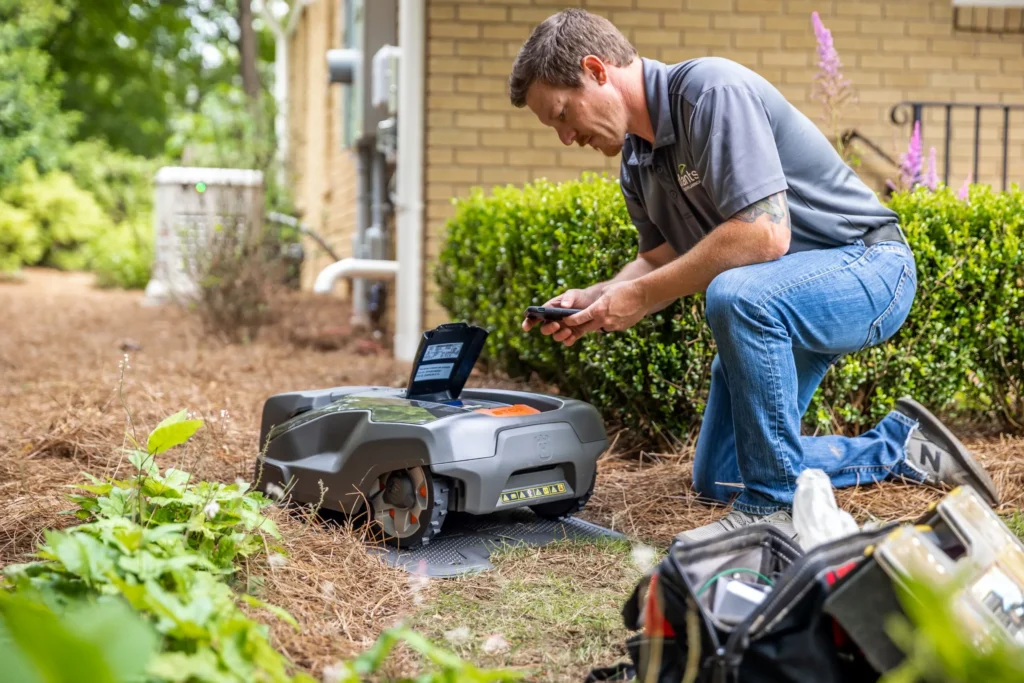
The mid-2010s marked the “RTK Revolution.” Real-Time Kinematic (RTK) positioning allowed mowers to move from random patterns to systematic, striped lines with centimeter-level accuracy. This was a critical turning point for the American market, as the “striped” look is a visual requirement for many high-end domestic landscapes. Furthermore, the shift from lead-acid to lithium-manganese-cobalt batteries allowed for the high-torque output necessary to maintain thick, humid-climate grasses without clogging.
While satellites provide the map, onboard cameras and LiDAR provide the nuance—identifying a fallen branch, a stray pet, or a new flower bed without requiring a manual update to the software. We have moved from a machine that follows a wire to a machine that “understands” the geometry of the estate.
Conceptual Frameworks and Mental Models
To manage a luxury robotic installation effectively, several mental models are useful:
1. The “Continuous Maintenance” vs. “Pulse Maintenance” Model
Traditional mowing is “Pulse Maintenance”—the lawn grows long and is then aggressively cut back. Robotic care is “Continuous.” Understanding this helps in evaluating turf health. In the continuous model, the plant spends less energy recovering from the “shock” of cutting and more energy on root development.
2. The Multi-Agent Fleet Framework
On estates over three acres, a single large machine is often less efficient than three smaller “agents.” This redundancy is a hallmark of luxury planning, ensuring that the visual standard of the property never drops.
3. The “Invisibility” Threshold
A successful system should reach a threshold where it is neither seen nor heard by the occupants. This involves scheduling mowers during “quiet hours” or utilizing the nearly silent electric motors during the night, provided the moisture levels of the grass allow for it.
Key Categories and Variations of Professional Systems
In the luxury sector, mowers are categorized primarily by their navigation logic and cutting capacity.
| Category | Navigation System | Capacity (Acres) | Typical Use Case |
| RTK-GNSS Professional | Satellite-based | 1.0 – 5.0+ | Sprawling estates with clear sky views. |
| Vision-Based Autonomous | Camera/LiDAR | 0.5 – 2.0 | Properties with heavy tree canopies. |
| Hybrid Wire/Satellite | Combined | 1.0 – 3.0 | Estates with “signal canyons” or complex walls. |
| AWD Slope Specialists | IMU + All-Wheel Drive | Up to 1.5 | Mountainous or terraced luxury properties. |
| Commercial-Scale Fleet | Server-Managed | 10.0+ | Multi-unit developments or massive estates. |
Decision Logic: Navigating the Selection
The choice of system is rarely about the brand and usually about the “Signal Integrity.” If the property is a cleared 2-acre lot in a coastal area, an RTK-GNSS system is the gold standard for its ability to produce perfect stripes. However, if the estate is a wooded retreat in the Pacific Northwest, a Vision-based system that doesn’t rely on a constant GPS lock is the only logical choice. A failure to match the navigation technology to the canopy cover is the most frequent cause of system abandonment.
Real-World Scenarios: Implementation and Constraints
Scenario 1: The Coastal Estate (High Salt, High Sun)
-
Constraint: Salt air corrosion and 24/7 sun exposure on plastic components.
-
Decision: Professional-grade chassis with UV-stabilized polymer and sealed electronics.
-
Failure Mode: “Salt-crust” on charging contact,s preventing docking.
-
Outcome: Implementation of a weekly “contact cleaning” protocol as part of the service contract.
Scenario 2: The Wooded Retreat (Signal Blockage)
-
Constraint: 80% canopy cover prevents GPS-based navigation.
-
Decision: A vision-based system that uses local landmarks (trees, rocks) to navigate.
-
Risk: Fall leaves obscuring “landmarks” or blocking the mower’s cameras.
-
Second-Order Effect: The need for a more aggressive leaf-clearing schedule than a traditional lawn would require.
Scenario 3: The Steep Terrain Mountain Home
-
Constraint: 35-degree slopes that cause standard mowers to lose traction or slide.
-
Decision: All-wheel-drive (AWD) robotic units with specialized tread.
-
Logic: AWD units distribute torque across four points, preventing the “turf tearing” that happens when two wheels spin in vain on a slope.
Planning, Cost, and Resource Dynamics
The economic argument for luxury robotic systems is often framed as “payback period” versus a mowing crew. However, in the luxury market, the value is better measured in “Opportunity Cost” and “Asset Appreciation.”
The Range of Investment (USA Market)
| Item | Estimated Cost (USD) | Frequency |
| Hardware (Unit + Base) | $5,000 – $18,000 | Every 5-7 years |
| Professional Installation | $1,500 – $4,000 | Once (per site) |
| Annual Service Contract | $500 – $1,500 | Yearly |
| Energy Consumption | $20 – $60 | Annually |
| Blade Replacement | $50 – $150 | Quarterly |
The direct cost is often higher in Year 1 than traditional services. However, by Year 3, the “Direct Labor” savings usually intersect with the initial investment. The “Indirect” benefit is the lack of heavy equipment on the driveway and the reduction in liability insurance risks associated with having contractors on-site.
Tools, Strategies, and Support Systems
A luxury installation is only as strong as its surrounding infrastructure.
-
RTK Reference Stations: A dedicated antenna mounted at the highest point of the property to provide local coordinate corrections.
-
Weather Station Integration: Linking the mower to local rain sensors to ensure it doesn’t “puddle” the lawn during heavy North American thunderstorms.
-
Dedicated Outdoor Power: Weatherproof, GFCI-protected outlets positioned strategically to minimize long low-voltage cable runs.
-
Signal Boosters/Mesh Wi-Fi: Ensuring the mower can receive “Over-the-Air” (OTA) updates and remote commands from any corner of the yard.
-
Fleet Management Software: An interface for the estate manager to track “Hours Mowed,” “Blade Health,” and “Battery Cycles.”
-
The “Winter Housing” Strategy: A climate-controlled storage plan to prevent battery degradation during sub-zero winters in the Northeast or Midwest.
Risk Landscape and Failure Modes
The primary risks in luxury robotic lawn carUSAsa are not mechanical, but environmental and digital.
-
Compounding Risks (The “Stuck” Loop): A mower that gets stuck in a soft spot during a rainstorm may spin its wheels, creating a hole that requires manual repair. If the sensors do not detect this “slippage,” the damage can be significant.
-
Cyber-Physical Attacks: As these devices are Wi-Fi connected, they represent an “edge” device in the home network. Ensuring they are on a guest VLAN is a standard luxury security requirement.
-
The “Vandalism/Theft” Myth: High-end mowers are equipped with GPS tracking, PIN locks, and high-pitch alarms. The risk of theft is statistically low, but the risk of “accidental damage” from children or pets is higher and requires proximity-sensor calibration.
Governance, Maintenance, and Long-Term Adaptation
A luxury system requires a “Governance” mindset.
The Maintenance Hierarchy
-
Daily: Automatic rain-sensor check and remote status monitoring.
-
Monthly: Visual inspection of blades; cleaning the undercarriage of grass buildup (crucial for maintaining energy efficiency).
-
Seasonally: Boundary optimization (if landscape beds have expanded or shrunk) and battery health diagnostic.
-
Annually: Professional “Winter Service”—deconstruction, deep cleaning, and seal inspection.
Measurement, Tracking, and Evaluation
Evaluating the success of an autonomous lawn program involves both quantitative data and aesthetic judgment.
Indicators of Success
-
Leading Indicators: Battery charge efficiency (minutes mowed per % of battery), signal strength consistency, and blade sharpness (measured by the “fray” on the tip of the grass blade).
-
Lagging Indicators: Total fertilizer reduction over 12 months, increase in turf density, and reduction in broadleaf weed intrusion (due to the “constant cut” preventing weeds from seeding).
Documentation Examples
-
The “Cut Map”: A heat-map showing which areas of the estate are being mowed most frequently.
-
Turf Health Log: A photo record of specific “trouble spots” taken at the same time each month to track recovery under autonomous care.
Common Misconceptions and Oversimplifications
-
“It’s just a Roomba for the grass.” A vacuum works in a controlled environment; a mower works in a dynamic, biological one. The complexity is exponentially higher.
-
“It can’t handle hills.” Modern AWD units can climb slopes that are dangerous for human-operated riding mowers.
-
“The blades are dangerous.” Robotic mowers use small, razor-like blades that have very little mass compared to a traditional 30-inch steel blade. They are designed to “tuck away” if they hit a hard object.
-
“It’s bad for the environment because of the battery.” When compared to the CO2 and NOx emissions of a gas-powered zero-turn mower, the carbon footprint is significantly lower, even when factoring in battery production.
-
“It will replace my gardener.” It replaces the mowing. It allows the professional gardener to focus on high-value tasks like pruning, fertilization strategy, and floral design.
Conclusion: The New Standard of Estate Management
The move toward autonomous turf care in the American luxury market is an inevitable progression of technology meeting ecological necessity. As we demand quieter neighborhoods and more sustainable living practices, the high-decibel maintenance of the past becomes an architectural anachronism. Luxury robotic lawn care is not a shortcut; it is a refined method of land management that prioritizes the health of the plant and the tranquility of the environment.
It requires a willingness to adapt, a focus on infrastructure, and an appreciation for the subtle, daily improvements that only a dedicated autonomous system can provide. The future of the American lawn is not one of less maintenance, but of smarter maintenance.