Top High Tech Patios in America: The 2026 Pillar Guide
The domestication of the American exterior has undergone a profound technological metamorphosis, moving away from the static hardscape of the late 20th century toward dynamic, responsive environments. In the contemporary luxury market, a patio is no longer merely a collection of pavers and outdoor furniture; it is a sophisticated node of integrated systems. These spaces are engineered to mitigate environmental volatility, utilizing automated louvered roofs, climate-responsive heating, and networked sensory arrays. The primary challenge for the modern property manager or homeowner is the seamless synthesis of these disparate technologies into a single, cohesive user experience.
As we examine the leading edge of outdoor living, we find that the “High Tech” designation is frequently misunderstood. It is not defined by the quantity of gadgets, but by the “Intelligence of Integration.” A superior patio environment utilizes data—from local anemometers, solar sensors, and hyper-local weather APIs—to proactively adjust its physical state. This might manifest as motorized screens lowering before a convective storm arrives or infrared heaters modulating their intensity based on ambient humidity and occupancy. The goal is to maximize “Usable Hours,” reclaiming the outdoors from the constraints of the climate.
Achieving this level of architectural performance requires an analytical approach to infrastructure. One must consider the signal propagation of Wi-Fi 7 across open spaces, the electrical load requirements of high-wattage radiant heaters, and the hydraulic complexities of automated misting systems. In the United States, where regional climates vary from the high-salinity coasts of Florida to the thermal extremes of the Mountain West, a “one-size-fits-all” technology stack is nonexistent. This definitive reference explores the technical frameworks, strategic planning, and operational nuances necessary to manage and sustain the most advanced outdoor living assets in the country.
top high-tech patios in amAmericao define the top high-tech patios in America, one must look beyond superficial automation. The hallmark of an elite-tier patio is “Environmental Fluidity”—the ability of the structure to change its physical properties in real-time. At the core of these installations is the bioclimatic pergola. Unlike a traditional roof, these structures utilize dual-walled aluminum louvers that can rotate 150 degrees to track the sun for optimal shading or close completely to form a watertight seal. In the most advanced American estates, these pergolas are equipped with rain sensors and “Ice-Melt” internal heating cables, ensuring that the technology itself is protected from the very elements it seeks to manage.

Another pillar of high-performance outdoor design is “Zonal Climate Orchestration.” In the luxury market, heating is no longer a binary “On/Off” proposition. These systems are tethered to occupancy sensors and smart dimmers, allowing the patio to maintain a “Comfort Constant” even as the sun sets and the temperature drops. This is often paired with high-pressure “Flash Evaporative” misting systems in warmer climates, which can drop the ambient temperature of a patio by up to 30 degrees without creating surface moisture, utilizing 1,000 PSI pumps and ceramic nozzles.
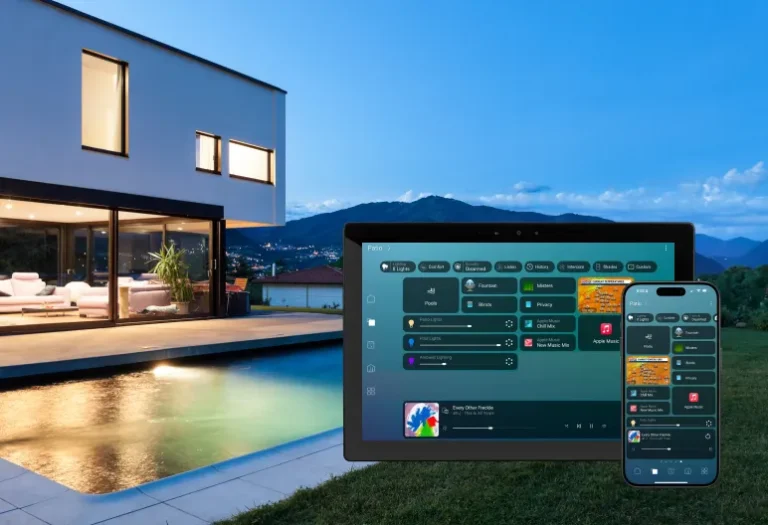
Finally, the digital backbone of the top high-tech patios in America relies on “Edge-to-Cloud Connectivity.” These spaces are integrated into enterprise-grade home automation platforms such as Crestron or Savant. This allows the patio to participate in “Global Home Scenes.” For instance, a “Dinner Party” command can simultaneously dim the landscape lighting to 20%, activate the hidden outdoor speakers with a specific acoustic profile, lower the motorized insect screens, and ignite the automated gas fire feature. This level of orchestration ensures that the technology serves the social experience rather than distracting from it.
Contextual Background: The Evolution of the Managed Exterior
The trajectory of the American patio has moved from the “Passive Masonry” era to the “Integrated System” era. In the mid-20th century, a high-end patio was defined by the quality of its flagstone and the proximity of the charcoal grill to the back door. The late 1990s introduced the first generation of outdoor-rated electronics—mostly heavy, boxy televisions and rudimentary “rock” speakers. These were “add-on” technologies that required manual intervention and offered limited durability.
In 2026, we have transitioned into the “Bioclimatic Era.” The patio is now viewed as an extension of the home’s building envelope. We no longer build patios; we engineer “Outdoor Living Modules” that are capable of operating independently of the primary residence’s HVAC and lighting systems.
Conceptual Frameworks and Mental Models
To manage a high-tech outdoor space, property owners should utilize specific mental models:
-
The “Envelope Extension” Model: View the patio as a flexible room. If the “walls” (motorized screens) and “ceiling” (louvers) can be modulated, you control the micro-climate.
-
The “Utility-to-Aesthetic” Ratio: Every piece of technology must provide a functional benefit (comfort, safety, or longevity) that justifies its aesthetic presence. If a sensor is visible, it should be because its placement is critical for data accuracy.
-
The “Maintenance-as-Insurance” Framework: In the harsh outdoor environment, technology is in a constant state of decay. Maintenance is not a chore; it is the “premium” paid to ensure the capital asset does not depreciate prematurely.
Key Categories of Smart Patio Infrastructure
Selecting the right technology stack depends on the regional climate and intended use case.
| Category | High-Performance Solution | Value Driver | Primary Constraint |
| Shelter | Bioclimatic Louvered Roof | 365-day usability | High structural load requirements |
| Climate | SWIR Infrared + Misting | “Comfort Constant” | High electrical amperage draw |
| Acoustics | Distributed 70V Landscape Audio | Even sound coverage | Requires significant trenching |
| Visuals | High-Bright (2,000+ nit) LED | Daytime visibility | Heat dissipation in enclosures |
| Connectivity | Outdoor PoE Access Points | “Always-On” reliability | Signal attenuation by foliage |
| Safety | AI-Integrated Thermal Cameras | Proactive security | Privacy considerations |
Realistic Decision Logic
A common decision for the top high-tech patios in America is the choice between Motorized Screens and Fixed Glass Curtains. Screens offer superior airflow and insect protection, making them ideal for the humid Southeast. Glass curtains provide a total thermal seal, essentially turning the patio into a sunroom, which is the preferred choice for the colder climates of the Pacific Northwest or New England.
Detailed Real-World Scenarios and Climate Stressors
Scenario 1: The “High-Wind” Automatic Retraction
In coastal areas like the Hamptons or Malibu, sudden gusts can destroy motorized awnings or screens.
-
The Problem: Kinetic energy from wind can tear fabric or bend guide rails.
-
The Strategy: Integration of a “Sonic Anemometer” (no moving parts) that triggers a “Hard-Retract” command when wind exceeds 35 MPH.
-
Failure Mode: Relying on a cloud-based weather report rather than a local sensor, as micro-bursts often occur without being reflected in regional data.
Scenario 2: The “Thermal Shock” of Snow
In mountain regions like Aspen or Park City, heavy snow can collapse a louvered roof.
-
The Problem: Weight accumulation exceeds the motor’s torque capacity to open.
-
The Strategy: Internal “Gutter Heat Tracing” and snow sensors that automatically open louvers to a 90-degree angle to allow snow to fall through, preventing accumulation.
Planning, Cost, and Resource Dynamics
The financial architecture of a high-tech patio is weighted toward infrastructure.
| Expense Component | Entry-Level Smart | Ultra-High-End Integrated | ROI Horizon |
| Bioclimatic Structure | $15,000 – $25,000 | $75,000 – $150,000+ | 10 – 15 Years |
| Climate Systems | $2,000 – $5,000 | $15,000 – $30,000 | 5 Years (Usage) |
| AV & Networking | $3,000 – $7,000 | $25,000 – $50,000 | 3 – 5 Years |
| Automation Logic | $1,000 (DIY Hub) | $10,000 (Pro-Integrated) | Immediate (Ease of Use) |
Opportunity Cost: Choosing to skip the “Dedicated Sub-Panel” for electricity. A high-tech patio with four heaters and a misting pump can pull 80–100 amps. Without a dedicated panel, the user will constantly face tripped breakers when the house HVAC and patio systems run simultaneously.
Tools, Strategies, and Support Systems
A world-class patio utilizes these specific support layers:
-
NEMA 4X Rated Hubs: All outdoor “brains” should be housed in corrosion-resistant, watertight enclosures.
-
PoE (Power over Ethernet): Running a single cable for both data and power to cameras and access points reduces the “Electrical Footprint.”
-
Pressure-Compensated Misting: Ensures that the first and last nozzles in a 100-foot line produce the same micron-sized droplet.
-
UV-C Air Purification: For semi-enclosed patios, integrated UV-C lights in the airflow can mitigate outdoor allergens and pathogens.
-
Direct-Burial Cabling: Using PE-jacketed wire that can withstand soil acidity and moisture for 20+ years.
-
Remote Power Management (PDU): Allows a technician to “Hard-Reboot” a frozen patio TV or controller from a remote location.
Risk Landscape and Failure Modes
The “Taxonomy of Risk” for top high-tech patios in America includes:
-
The “Seal Breathing” Effect: As enclosures heat up and cool down, they suck in moist air. Without “Breather Vents,” internal condensation will destroy the electronics.
-
Galvanic Corrosion: Mixing stainless steel fasteners with aluminum pergolas in coastal areas. Without nylon isolators, the metals will “fuse” or corrode at the contact point.
-
Firmware Desynchronization: An update to a home’s main router that inadvertently blocks the “MAC Address” of an outdoor controller, rendering the screens or lights unresponsive.
Governance, Maintenance, and Long-Term Adaptation
A high-tech patio is a “Managed Asset,” not a “Set-and-Forget” product.
Layered Maintenance Checklist:
-
Monthly: Clear debris from louver gutters. A single leaf can cause an overflow that shorts out an internal LED driver.
-
Quarterly: Inspect “Screen Tracks.” Lubricate motorized guides with “Dry Silicone” to prevent motor strain.
-
Annually: Perform a “Load Test” on the heater circuits. Inspect infrared elements for “Clouding” or cracks.
-
Post-Season: In cold climates, “Blow-Out” the misting lines with compressed air to prevent freeze-cracking of the pump.
Measurement, Tracking, and Evaluation
True topical authority requires documenting performance through “Environmental KPIs”:
-
Leading Indicators: “Signal Strength (RSSI)” at the furthest patio node. If it drops below -65dBm, the network requires a “Mesh Leaf” addition.
-
Lagging Indicators: “Annual Maintenance-to-Value Ratio.” If maintenance exceeds 5% of the initial cost annually, the system architecture is inefficient.
-
Qualitative Signal: “Usable Hour Increase.” Tracking how many days the patio was used in “Off-Peak” months (e.g., November in Chicago).
Common Misconceptions and Industry Myths
-
“Outdoor TVs are just bright indoor TVs.” False. Outdoor TVs have “Internal Heating/Cooling” and specialized coatings on the glass to prevent “Isotropic Blackout” (black spots caused by the sun heat).
-
“Wireless is always better.” In the outdoor environment, “Wireless” is the point of failure. The best patios use “Wired Backhauls” for everything that doesn’t move.
-
“Infrared heaters heat the air.” They do not. If you stand in the “Shadow” of a pillar, you will be cold, even if the heater is 5 feet away. Placement is about “Line of Sight.”
-
“Smart patios are more fragile.” If engineered correctly, a smart patio is more durable because it can retract its own vulnerable components before a storm arrives.
Conclusion
The engineering of the top high-tech patios in America represents the pinnacle of modern “Lifestyle Hardening.” These spaces serve as a testament to the idea that with the correct synthesis of material science and digital logic, the boundary between the home and the horizon can be effectively dissolved. Success in this category is not found in the complexity of the remote control, but in the reliability of the environment. A superior patio understands its surroundings, responds to the atmosphere, and provides a stable, luxurious sanctuary regardless of the American climate’s volatility.